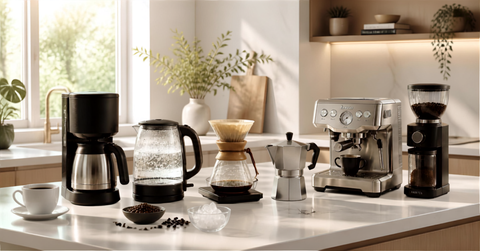
A beautiful coffee can taste unexpectedly sharp, thin, or bitter because of one quiet variable: the water in your kettle. This coffee water temperature guide gives you a practical starting point, then shows how to adjust heat for the coffee, brewer, and flavor experience you want. Once you notice the difference, water temperature stops feeling like a fussy detail and becomes one of the easiest ways to make your daily ritual more consistent.
Specialty-grade coffee earns its character through careful cultivation, hand-picking, defect control, and small-batch roasting. Those floral aromatics in a bright Colombian coffee, the cocoa depth of a Guatemala, or the earthy richness of a Sumatra are all present in the bean. Water temperature helps decide how much of that character reaches your cup.
The Best Coffee Water Temperature Range
For most brewed coffee, use water between 195°F and 205°F. That range is the reliable home-brewing standard because it extracts flavorful compounds efficiently without making the process unnecessarily difficult. If you have a temperature-controlled kettle, begin at 200°F and adjust from there.
Hot water is an active solvent. It pulls acids, sugars, aromatic compounds, and eventually more drying, bitter components from ground coffee. Water that is too cool often leaves the cup under-extracted: tart, salty, watery, or oddly hollow. Water that is too hot can push extraction too far, especially with very dark roasts or a long brew time, producing bitterness and a rough, astringent finish.
Still, the thermometer does not tell the entire story. Grind size, dose, water-to-coffee ratio, agitation, brew time, filter type, and the freshness of the roast all influence extraction. Think of temperature as a precise, useful lever - not a rule that overrules every other part of the brew.
Coffee Water Temperature by Brewing Method
Different brewers create different contact times and levels of agitation. Use these ranges as thoughtful starting points rather than fixed laws.
Pour-over: 198°F to 205°F
Pour-over brewing rewards attention because each pour shapes the extraction. For a light or medium-light single-origin coffee, start around 202°F to 205°F. The higher end of the range can help reveal sweetness and clarity in dense, lightly roasted beans, especially when you are brewing a coffee with citrus, stone fruit, or floral notes.
For medium roasts, 200°F to 202°F is a comfortable center point. If the coffee tastes dry, harsh, or overly roasty, lower the water by a few degrees before making major changes to your recipe. A lower temperature can soften the edges while preserving the coffee's body.
Preheat your dripper, server, and mug. A cool ceramic brewer steals heat from the slurry, meaning water that leaves the kettle at 202°F may be far cooler when it reaches the grounds.
Automatic drip coffee: 195°F to 205°F
A quality drip machine should deliver water in this zone, though performance varies from one brewer to another. Choose a medium grind and let the machine do the work, then evaluate the cup before changing your coffee. If it consistently tastes weak despite the right ratio, the machine may not be reaching adequate brewing temperature.
Drip coffee is especially sensitive to stale grounds. Freshly ground, roast-to-order specialty coffee gives temperature adjustments something worthwhile to work with. Pre-ground coffee that has lost much of its aroma can taste flat at nearly any setting.
French press: 195°F to 200°F
French press coffee has a long immersion time, usually about four minutes, and its metal filter allows more oils and fine particles into the cup. For that reason, it often benefits from slightly cooler water than a quick pour-over. Start at 198°F for a medium roast.
If you prefer a fuller, more intense cup, try 200°F. If a dark roast becomes smoky or bitter, move toward 195°F. Because the grounds remain in contact with water until pressing and pouring, avoid letting the finished coffee sit in the press for too long.
AeroPress: 175°F to 205°F
The AeroPress is wonderfully flexible. A standard approach with medium or medium-dark coffee often works well around 185°F to 195°F. The lower temperature can produce a sweet, smooth, low-bitterness cup, particularly with a finer grind and a brief steep.
For a light roast, raise the temperature toward 200°F to 205°F. The trade-off is simple: cooler water offers gentleness, while hotter water provides more extraction power. Let the coffee's roast level and your preferred texture guide you.
Espresso: 198°F to 203°F at the group head
Espresso machines are usually discussed in terms of brew temperature, but that temperature is measured at or near the group head, not in a kettle. A common starting point is 200°F. Lighter roasted espresso may benefit from 201°F to 203°F to bring out more sweetness and avoid sourness. Darker espresso often tastes more balanced around 198°F to 200°F.
With espresso, change only one variable at a time. If a shot is sour, a slightly hotter temperature may help, but so might a finer grind or a longer yield. If it tastes bitter and drying, try a slightly cooler setting, a coarser grind, or a shorter yield.
Cold brew: Room temperature or cold water
Cold brew is the exception to the hot-water rule. It extracts slowly over many hours with room-temperature or cold water. The result is typically smooth, mellow, and lower in perceived acidity. Heating the water would create an entirely different beverage, so save the kettle for your hot brewing methods.
Adjust Temperature for Roast Level and Flavor
Roast level offers a helpful shortcut. Lighter roasts are less porous and can be harder to extract, so they often respond well to hotter water. Start around 202°F. Medium roasts are versatile and usually shine near 200°F. Dark roasts are more soluble, making 195°F to 200°F a sensible place to begin.
But labels are not the whole story. A carefully developed medium roast may taste lively and dense enough to enjoy at 203°F, while a light roast with delicate florals may become less graceful if pushed too aggressively. Taste is the final authority.
Consider the profile you are chasing. Higher temperatures can emphasize intensity, structure, and deeper sweetness when extraction is otherwise lacking. Lower temperatures can highlight a softer mouthfeel and reduce roast-driven bitterness. Neither choice is universally better. A coffee brewed for a bright, tea-like pour-over experience may call for a different temperature than the same coffee prepared as a comforting, chocolate-toned French press.
How to Brew Without a Temperature-Controlled Kettle
You do not need specialized equipment to make excellent coffee. Bring fresh water to a full boil, remove it from the heat, and wait about 30 seconds before brewing. In many home kitchens, that lands near the upper end of the recommended range. Waiting 45 to 60 seconds generally brings the water closer to 200°F, depending on your kettle, room temperature, and the amount of water inside.
Avoid repeatedly boiling the same water if you can. Start with fresh, cold water each time. Coffee is mostly water, so its mineral balance and cleanliness matter as much as its heat. Water that tastes heavily chlorinated, overly hard, or unusually soft can blur the definition and sweetness that make specialty coffee memorable.
A simple digital thermometer is another inexpensive option. It is particularly useful when you are learning a new brewer or trying to understand why one bag tastes different from another.
Troubleshooting Your Cup With This Coffee Water Temperature Guide
If the coffee tastes sour, sharp, or underdeveloped, raise your temperature by 2°F to 4°F, especially for a light roast. If it is bitter, woody, or drying, lower it by the same amount. Keep the grind, ratio, and brewing time unchanged for that test. Otherwise, you will not know which adjustment improved the cup.
If your coffee tastes both sour and bitter, temperature may not be the main issue. That combination often points to uneven extraction caused by inconsistent grinding, channeling in espresso, poor pouring technique, or an uneven coffee bed. Use a good burr grinder, wet all grounds evenly during the bloom, and pour with a calm, controlled rhythm.
At higher elevations, water boils below 212°F, so you may not be able to reach the top of the standard range. That is normal. Brew with water just off the boil and consider a slightly finer grind or longer contact time if the cup seems under-extracted.
The most rewarding approach is to keep a small note beside your brewer: coffee, roast level, method, temperature, and one sentence about the taste. Over a few mornings, those observations turn a good bag of coffee into a personal map of flavor. Travel the world with every sip, then let your palate choose the temperature that brings each origin home.
Comments (0)
There are no comments for this article. Be the first one to leave a message!