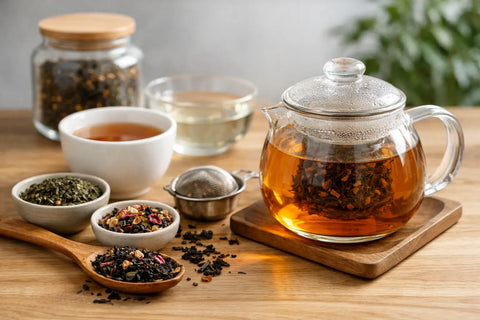
A memorable cup of tea usually begins before the kettle boils. The leaves may carry the floral lift of a spring green tea, the toasted warmth of an oolong, or the brisk malty character of a full-bodied black tea. A thoughtful loose leaf tea brewing guide helps those details arrive in your cup instead of getting lost beneath water that is too hot, too cool, or left steeping too long.
Loose-leaf tea gives you more room to taste the craft behind the leaf. Whole or larger leaf pieces have space to unfurl, releasing aroma and flavor gradually. The good news is that brewing them well does not require a laboratory setup. A few reliable measurements, fresh water, and the willingness to make one small adjustment at a time will take you far.
Start With Leaves, Water, and Room to Expand
Tea needs room. Whether you use a basket infuser, a teapot with a roomy filter, or a simple brewing basket placed over a mug, choose an infuser that lets the leaves open fully. Small tea balls can work for tightly rolled teas, but they often crowd larger leaves and limit extraction.
For most teas, begin with about 1 teaspoon of loose leaf tea per 8 ounces of water. This is a useful starting point, not an unbreakable rule. Large, airy leaves such as white tea or some herbal blends may need closer to 1 1/2 to 2 teaspoons because they take up more volume. Dense, tightly rolled oolongs may look modest in the spoon but expand dramatically once brewed.
If you prefer a more concentrated cup, use more leaves before you extend the steep time. Adding leaves builds body and aroma while keeping the tea's character intact. Steeping longer can bring out unwanted bitterness or drying astringency, particularly in green and black teas.
Water matters just as much as the leaves. Filtered water is often a worthwhile upgrade if your tap water has a noticeable mineral, chlorine, or metallic taste. Tea is mostly water, so a clean, neutral-tasting base lets the origin and processing of the leaves speak clearly.
Loose Leaf Tea Brewing Guide: Match Heat to Tea Type
Boiling water is not the universal answer. Delicate teas can become sharp or grassy when hit with a rolling boil, while sturdy black teas and herbal blends need higher heat to develop their full flavor. If you do not have a variable-temperature kettle, bring water to a boil and let it rest for a few minutes for lower-temperature teas.
Green tea and white tea
Brew green tea around 170 to 185°F for 1 1/2 to 3 minutes. Japanese-style green teas are often especially sensitive to heat and may taste sweeter at the lower end of that range. Chinese green teas can sometimes welcome slightly warmer water, depending on the leaf style.
White tea is generally beautiful around 175 to 185°F and can steep for 2 to 4 minutes. Its pale color can be misleading. A good white tea may offer honeyed, floral, or soft fruit notes, but it needs enough leaf and enough time to show them.
Oolong tea
Oolong spans a wide world of styles, from fragrant, lightly oxidized leaves with orchid-like aromas to dark, roasted teas with a nutty finish. Brew most oolongs around 190 to 205°F for 2 to 4 minutes. Rolled oolongs often need a little extra time on the first infusion as the leaves begin to open.
Black tea, pu-erh, and herbal tea
Black tea typically performs well with water at 200 to 212°F and a 3 to 5 minute steep. A delicate black tea may be best at three minutes, while a hearty breakfast-style blend can take four or five. Pu-erh, with its earthy depth and often complex aged character, is usually brewed close to boiling and can be steeped repeatedly.
Herbal teas, including chamomile, peppermint, rooibos, and many fruit blends, also benefit from fully boiling water. Steep for 5 to 7 minutes, or longer when the blend calls for it. Since herbal infusions do not come from the Camellia sinensis tea plant, they do not contain tea tannins in the same way and are generally more forgiving of a long steep.
A Simple Brewing Method That Works Every Day
Heat fresh water, rather than reheating water that has been sitting in the kettle. Measure your leaves into a roomy infuser or pot, then pour the water over them. Set a timer instead of relying on memory, especially while you are learning a new tea.
When the timer ends, remove the leaves or pour all the tea out of the pot. Leaving the leaves in the water is the most common reason a good tea turns unpleasantly bitter. If you are brewing in a mug with a basket infuser, lifting the basket promptly makes a noticeable difference.
Take a sip before adding milk, lemon, or sweetener. There is nothing wrong with enjoying tea your favorite way, but tasting it plain first gives you a clearer read on the leaf. You may find that a naturally cocoa-like black tea needs less sweetener than expected, or that a bright citrus herbal blend is already lively enough on its own.
For iced tea, make a slightly stronger hot infusion rather than steeping the leaves longer. Use roughly 1 1/2 teaspoons of tea per 8 ounces of water, brew at the recommended temperature and time, then pour over ice. This preserves flavor without drawing out excess tannin.
How to Fix a Cup That Missed the Mark
Tea brewing is wonderfully adjustable. If your cup tastes bitter, dry, or harsh, try cooler water, a shorter steep, or both. Green tea is the usual culprit here, though over-steeped black tea can become rough as well.
If the tea tastes thin or watery, first add more leaves. If it still lacks presence, steep a little longer next time. The distinction matters: more leaves increase flavor concentration, while more time increases extraction. For a tea that tastes dull, the issue may be water quality or leaves that have been stored too long near heat, light, or strong pantry odors.
A tea that tastes overly grassy can be under-extracted, especially with green tea. Try a slightly warmer temperature or an additional 30 seconds. A tea that seems muted but not unpleasant may simply need a larger dose of leaf. Keep notes if you are trying a new tea, even if the note is as simple as “better at two minutes.” That small record turns an ordinary morning mug into a personal tasting practice.
Re-Steep the Leaves and Follow Their Story
Many quality loose-leaf teas are made for more than one infusion. Oolongs, white teas, pu-erhs, and whole-leaf green teas often reveal a different side of themselves with each steep. The first cup may be fragrant and light; the second can become rounder, sweeter, or more mineral.
For a second infusion, use the same water temperature and add 30 seconds to a minute. Continue as long as the leaves still offer satisfying flavor. Black teas and herbal blends may give one or two good steeps, while a well-made oolong can often carry you through several. It depends on the leaf, the size of the brew, and how generously you measured at the start.
This is one of the quiet pleasures of loose-leaf tea: it encourages you to slow down without asking for perfection. At Artisan Java & Tea, we see tea as a small journey of aroma, place, and craft. Let your kettle, your favorite cup, and a fresh scoop of leaves create a pause worth returning to.

Comments (0)
There are no comments for this article. Be the first one to leave a message!