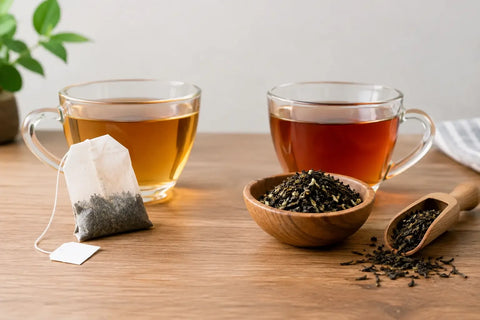
A quiet morning can turn on a small decision: reach for the familiar tea bag, or scoop fragrant leaves into an infuser and give them room to open. The tea bags versus loose leaf question is not really about choosing the “right” kind of tea. It is about deciding what matters in that moment - speed, flavor, cleanup, value, or the pleasure of slowing down long enough to watch a leaf unfurl.
Both formats can make a satisfying cup. But the details of leaf size, freshness, water flow, and brewing space have a real effect on what reaches your cup. Once you understand those differences, choosing becomes much easier.
Tea Bags Versus Loose Leaf: The Main Difference
The biggest distinction is what is inside. Traditional tea bags often contain small leaf particles, sometimes called fannings or dust. These pieces brew quickly because they expose a lot of surface area to water. That makes them practical for busy mornings, office drawers, travel, and any moment when a kettle is available but a full tea setup is not.
Loose-leaf tea generally contains larger, more intact leaves, along with visible herbs, spices, flowers, or fruit pieces when the blend calls for them. Whole and larger leaf pieces tend to release their character more gradually. In a good loose-leaf tea, you may notice flavor arriving in layers: a bright first aroma, a rounded middle note, then a lingering sweetness, gentle spice, or drying finish.
Neither leaf size automatically guarantees quality. A thoughtfully made tea bag can be enjoyable, and a poorly stored loose-leaf tea can taste flat. Still, loose leaf gives growers, blenders, and tea drinkers more opportunity to preserve and experience the leaf’s natural complexity.
Why Loose-Leaf Tea Often Tastes More Expressive
A tea leaf is not meant to stay tightly compressed. As it absorbs hot water, it expands, twists, and releases aromatic compounds. Loose leaves have room to move in an infuser, teapot, or basket. That circulation helps water reach more of the leaf evenly, which can produce a clearer and more dimensional cup.
This matters especially with teas valued for subtlety. A green tea may offer fresh grassiness, chestnut-like warmth, or a soft vegetal sweetness. An oolong can move between orchid-like florals, roasted grain, stone fruit, and cream. Black tea may carry notes of malt, cocoa, dried fruit, honey, or brisk tannin. When the leaf is larger and well kept, those details are easier to find.
There is also the matter of aroma. Opening a pouch of loose leaf is part of the experience: citrus peel, bergamot, toasted spice, jasmine, mint, or the deep, earthy scent of a dark tea. The dry leaf tells a story before the water ever meets the cup.
At Artisan Java & Tea, that sense of discovery is central to a curated loose-leaf tea selection. A well-made cup can be a small journey - one that fits into an ordinary afternoon without asking for a passport.
Freshness Has a Bigger Role Than Many People Expect
Tea does not spoil in the same dramatic way as fresh food, but it does lose fragrance and vibrancy over time. Air, heat, moisture, and light are the usual culprits. Small tea particles have more exposed surface area, so they can lose aromatic oils faster than intact leaves when packaging and storage are not carefully managed.
For loose tea at home, keep leaves in an airtight, opaque container away from the stove, a sunny counter, and strongly scented pantry items. Tea readily absorbs odors, so storing it beside coffee, spices, or scented candles can change its character. Buy an amount you will enjoy while it is still lively rather than treating tea as a long-term pantry collectible.
Where Tea Bags Win
Convenience is not a lesser value. A tea bag is simple, consistent, portioned, and easy to carry. If your daily tea ritual happens between school drop-off and a video call, or at a desk with limited space, that practicality can be exactly what you need.
Tea bags are also useful when you are serving a group with different preferences. A selection of individually wrapped bags lets guests choose without needing multiple infusers or a sink full of teaware. They can be a dependable option for iced tea experiments, road trips, hotel stays, and workplaces where a polished tea station is not realistic.
The trade-off is usually flexibility. A pre-portioned bag gives you less control over leaf quantity, and the bag itself can restrict expansion. Some bags are generously sized and contain whole leaves; others are compact and filled with finely cut tea. The material matters, too. A roomier sachet generally gives leaves more space than a flat, tightly packed paper bag.
If tea bags are your preferred format, steep with fresh water at the recommended temperature and remove the bag when the tea tastes balanced. Letting it sit indefinitely does not make it stronger in a good way. It often draws out more bitterness and astringency instead.
The Practical Case for Loose Leaf
Loose leaf asks for one extra tool, not a cabinet full of specialized equipment. A basket infuser that sits inside your favorite mug is enough to begin. It gives leaves generous space, is easy to clean, and makes it simple to lift the leaves out when the steep is finished.
Start with roughly one teaspoon of tea per eight ounces of water, then adjust according to the leaf and your taste. Large, airy leaves may need more volume than dense, rolled leaves. Rather than judging by a universal spoonful, pay attention to the cup. If the tea tastes thin, use a little more leaf or steep slightly longer. If it tastes bitter, try cooler water, a shorter steep, or a smaller amount of tea.
Loose leaf can also offer good value over time. Many quality teas can be steeped more than once, especially oolongs, white teas, and certain green teas. The second infusion may not taste identical to the first. Often it becomes softer, sweeter, or more revealing. That changing character is one of loose leaf’s quiet pleasures.
Water Temperature Changes Everything
Boiling water is not the answer for every tea. Black teas and herbal blends generally welcome water near a full boil. Green and white teas are more delicate and often taste better with cooler water. Water that is too hot can make them harsh, overly vegetal, or bitter before their sweeter notes have a chance to emerge.
You do not need laboratory precision. If you do not have a temperature-controlled kettle, let boiling water rest for a few minutes before brewing green or white tea. More useful than chasing a perfect number is tasting with attention and making one adjustment at a time.
How to Choose Based on Your Day
Choose tea bags when portability, speed, and minimal cleanup are at the top of the list. They are a smart companion for rushed mornings and straightforward cups of breakfast tea, peppermint, chamomile, or familiar flavored blends.
Choose loose leaf when you want to notice the tea itself. It is the better match for a weekend pot, a midafternoon reset, a thoughtful gift, or any cup where aroma and evolving flavor are part of the point. Loose leaf is particularly rewarding when you are exploring single-origin teas or blends with distinctive whole ingredients.
There is no need to build your tea shelf around one format alone. Many tea drinkers keep both: tea bags for the grab-and-go moments, loose leaf for the cups they want to linger over. That is not a compromise. It is simply matching the tea to the occasion.
A Better Cup in Either Format
Whatever you brew, begin with fresh, cold water rather than water that has been repeatedly boiled. Give the tea enough room, use a clean cup, and avoid steeping by habit alone. Taste at the suggested time, then decide whether you want more body, more brightness, or less tannin next time.
The most useful tea education happens one cup at a time. Brew a familiar tea bag beside a loose-leaf version of a similar style when you have a few unhurried minutes. Notice the aroma, color, texture, and finish. Your own palate will tell you far more than a rule ever could - and it may lead you to a new favorite ritual.

Comments (0)
There are no comments for this article. Be the first one to leave a message!