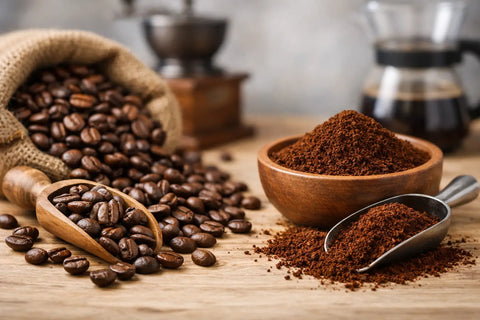
The moment a coffee bag is opened, its most delicate aromatics begin to move. That is why the whole bean vs ground coffee decision changes more than your morning routine. It shapes how much fragrance reaches your kitchen, how clearly you taste a coffee’s origin, and how much hands-on time your first cup requires.
For a lively pour-over with notes of citrus, cacao, or stone fruit, whole beans usually offer the clearest path. For a fast weekday pot of coffee, pre-ground coffee can be the sensible choice. Neither format is a moral test of coffee knowledge. The better choice is the one that lets you make a satisfying cup consistently, with the equipment and time you actually have.
Whole Bean vs Ground Coffee: The Essential Difference
Coffee is at its most protected while it remains a whole bean. The roasted bean acts as a small natural container, helping preserve the aromatic compounds and oils that create flavor. Once coffee is ground, vastly more surface area is exposed to oxygen, light, moisture, and the scents around it.
That exposure is useful when brewing. Water needs access to the coffee particles to extract flavor. But it also means ground coffee loses its vivid character more quickly than whole beans. A freshly ground Guatemala may smell like toasted almond and caramel; a bright Colombia may offer a sweet, fruit-forward lift. Those details can become quieter after the coffee has spent time pre-ground.
This does not mean every bag of ground coffee is poor coffee. Freshly roasted, carefully packaged ground coffee can make a very enjoyable cup, especially when it is used promptly and stored well. The difference is that whole beans give you more control over the freshness window.
Why Whole Beans Often Taste More Expressive
Specialty-grade coffee earns its character through many decisions before it reaches the roaster: ripe cherry selection, careful processing, defect control, and thoughtful roasting. An 80+ SCA-scored coffee can carry a remarkable amount of place in the cup. Grinding just before brewing helps preserve that work.
Fresh grinding preserves aroma
Aroma is not a decorative extra. It is a major part of what we experience as flavor. Grind a spoonful of beans immediately before brewing and you will notice the difference in the air above the brewer. Those volatile aromatics are most available right after grinding, which is one reason a fresh-ground cup can feel more layered and complete.
Whole beans are especially rewarding when you enjoy single-origin coffee. A Peru with gentle chocolate notes, a deeper Sumatra, or a balanced Honduras can each show a distinct personality. Fresh grinding makes it easier to notice the contrast rather than tasting only roastiness or bitterness.
You can tailor the grind to the brewer
Grind size determines how quickly water extracts coffee. A French press needs a coarse grind so sediment stays manageable and the coffee does not over-extract. Drip brewers generally perform well with a medium grind. Espresso needs a much finer, more precise grind, while cold brew calls for a coarse setting and a long steep.
With whole beans, you can adjust as your brewer, recipe, and taste change. If a pour-over tastes sour or thin, a slightly finer grind may help. If it tastes harsh, dry, or overly bitter, a slightly coarser grind can slow extraction. Small changes matter, and a burr grinder makes those changes far more consistent than a blade grinder.
Whole beans keep longer when stored thoughtfully
Keep coffee in an airtight container, away from heat, direct sunlight, and moisture. A cool cabinet is generally better than a shelf beside the oven or a clear jar on a sunny counter. Avoid the refrigerator, where coffee can pick up odors and encounter condensation.
Buy a quantity you expect to enjoy while the coffee is still tasting vibrant, rather than stocking up for months. For many households, a bag every few weeks fits naturally. Roast-to-order coffee is particularly enjoyable here because you begin with coffee that has not been sitting in a warehouse long before it reaches your kitchen.
When Ground Coffee Is the Better Choice
Convenience is not a compromise if it helps you brew coffee you love. Pre-ground coffee is practical for busy households, office kitchens, travel, camping, or anyone who does not want another appliance on the counter. It can also be a welcoming entry point for newer specialty-coffee drinkers who are still deciding whether they enjoy the ritual of manual brewing.
Ground coffee is also useful when the brewing method is fixed. If you use the same automatic drip machine every morning, a grind selected for drip can offer reliable results without daily adjustment. The key is choosing coffee ground for your brewer, buying in sensible quantities, and sealing the bag tightly between brews.
There is a financial consideration, too. A capable burr grinder is an investment. If a grinder would stretch the coffee budget so far that you must choose lower-quality beans, excellent pre-ground specialty coffee may be the wiser purchase. Quality coffee, fresh roasting, clean water, and a well-maintained brewer still count for a great deal.
Match Your Coffee Format to Your Brewing Style
The strongest argument for whole beans comes from brewing methods that reward precision. Espresso is the clearest example. Espresso machines respond dramatically to tiny grind adjustments, and coffee ground days ago is less likely to produce the rich crema and balanced extraction many home baristas want. Pour-over and AeroPress brewing also benefit from a grinder because you can refine a recipe as you go.
For a standard drip machine, the gap can be smaller. A good pre-ground coffee, used soon after opening, can produce a warm, flavorful daily cup with very little effort. If your goal is to make mornings easier, that convenience has real value.
French press and cold brew sit in the middle. Coarse pre-ground coffee can work well, but freshly grinding beans gives you more control over sediment and strength. Cold brew is forgiving because of its long extraction, yet it can still taste cleaner and more aromatic when made from recently ground beans.
Coffee pods, instant coffee, and ready-to-use formats serve another purpose altogether: speed, consistency, and portability. They are not substitutes for the tactile ritual of grinding a single-origin coffee, but they can be exactly right for a workday, guest room, road trip, or afternoon when time is short.
A Practical Buying Routine for Better Coffee
If you are choosing whole beans, start simply: buy a modest bag, use a burr grinder if possible, and grind only what you need for each brew. Begin with the grinder setting recommended for your method, then adjust gradually rather than changing several variables at once. Use filtered water when your tap water has a pronounced taste, and measure both coffee and water so a great cup is repeatable.
If you choose ground coffee, select the grind for your brewer and plan to use it with intention. Close the package immediately after scooping, keep it in a cool, dark place, and resist the urge to store it in the refrigerator. A smaller bag that is finished at its peak is often more rewarding than a large bag that lingers in the cabinet.
At Artisan Java & Tea, the goal is not to make coffee feel complicated. It is to help you travel through origins, roasts, and brewing styles with confidence, whether your ideal morning includes a hand grinder and scale or one well-made pot before the day begins.
The best coffee ritual is the one you will return to tomorrow. Choose whole beans when you want maximum aroma, flexibility, and a closer connection to the cup. Choose ground coffee when ease helps you enjoy specialty coffee more often. Then give yourself a moment to notice what is in the mug: the fragrance, the sweetness, and the small journey from a coffee-growing region to your table.
Comments (0)
There are no comments for this article. Be the first one to leave a message!