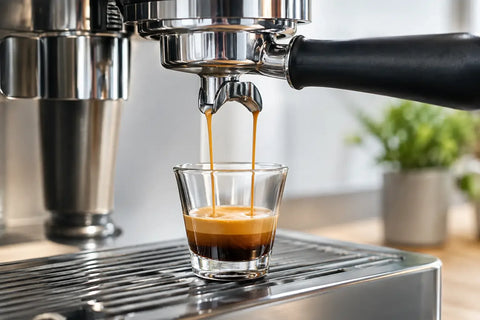
A shot that runs for 28 seconds can taste bright, syrupy, and beautifully balanced. Another shot at the same time can taste sharp or dry. That is why learning to dial espresso shot timing means looking beyond the clock. Time is a useful signal, but dose, beverage weight, grind, coffee freshness, water, and taste all share the work.
For home baristas, this is good news. You do not need to chase a mythical perfect number. You need a repeatable starting point and a clear way to respond to what is in the cup. With fresh specialty-grade coffee, a scale, and a little patience, dialing in becomes less like guesswork and more like getting acquainted with the coffee in your grinder.
What espresso shot timing actually tells you
Shot time measures how long water takes to travel through the coffee puck, usually from the moment you start the pump. It helps you understand resistance. A very fast shot often means water moved through too easily. A very slow shot usually means the puck offered too much resistance.
But timing is not flavor by itself. A fine grind can create a 30-second shot, as can a larger dose or a more restrictive basket. Two shots with the same time can have completely different extraction and texture. Think of time as a compass, not a destination.
A dependable starting recipe for many traditional double espressos is a 1:2 brew ratio. If you put 18 grams of ground coffee into the portafilter, aim for about 36 grams of espresso in the cup. Depending on the coffee and machine, that may take roughly 25 to 32 seconds.
That range is a starting point, especially with a medium or medium-dark espresso roast. A lively light-roasted single-origin coffee may taste better with a longer ratio, such as 18 grams in and 40 to 45 grams out. A fuller, more developed roast may shine at a slightly shorter yield. The coffee gets the final vote.
The setup that makes timing useful
Before changing the grinder, make sure your basic workflow is consistent. An inconsistent dose or uneven puck can make every shot look like a grinder problem when it is really a preparation problem.
Use a scale that reads to 0.1 gram. Weigh the dry dose going into the basket and the liquid espresso coming out. Use the same basket each time, and choose a dose that fits its stated range. An overfilled basket can cause puck contact with the shower screen, while an underfilled one may leave extra headspace and change how water moves through the coffee.
Distribute grounds as evenly as possible before tamping. A simple needle tool or a few careful taps can break up clumps, particularly with a fine espresso grind. Tamp level and firm. There is no need to press with theatrical force. Once the grounds are compacted evenly, pressing harder does not make the espresso better. A level puck matters far more.
Start your timer with the pump. If your machine has a noticeable pre-infusion phase, keep your timing method the same from shot to shot. Consistency lets you compare results honestly.
Freshness matters, too. Small-batch roasted coffee has aromatic, soluble compounds worth protecting, but it also changes as it rests. Many coffees settle into a good espresso window several days after roasting and can continue evolving for weeks. If yesterday's recipe suddenly runs faster today, the coffee may be aging, the weather may be more humid, or your grinder may simply need a small adjustment.
How to dial espresso shot timing, step by step
Begin with one recipe and hold it steady long enough to learn from it. For example, use 18 grams of coffee, target 36 grams of espresso, and see where the shot lands in time. Taste it after it has cooled for a moment. Extremely hot espresso can hide sweetness and exaggerate bitterness.
If the shot reaches 36 grams in under about 25 seconds and tastes thin, sour, salty, or abruptly sharp, grind finer. Finer particles slow the flow and expose more coffee surface to the water, helping extract sweetness and depth. Make a modest adjustment, purge a little retained coffee if your grinder needs it, then pull the next shot with the same dose and yield.
If the shot takes longer than about 32 to 35 seconds to reach the target and tastes dry, woody, harsh, or intensely bitter, grind coarser. Coarser grounds allow water through more easily and can reduce overextraction. Again, change one thing, then taste.
The key is to avoid making three corrections at once. If you alter dose, grind, yield, and tamp in a single attempt, you may improve the cup without knowing why. Change the grind first when flow is clearly too fast or slow. Once flow is close, use yield to fine-tune flavor.
Use yield to shape the cup
Your final beverage weight is one of the most powerful controls you have. A shorter yield, such as 18 grams in and 30 to 32 grams out, often produces a denser, more concentrated shot. It can suit chocolate-forward coffees and milk drinks, though it may leave a bright coffee tasting underdeveloped if pushed too short.
A longer yield, such as 18 grams in and 40 grams out, can bring out more sweetness, fruit, and clarity. It may be especially rewarding with coffees that carry notes of citrus, stone fruit, florals, or caramel. Go too long, however, and the shot can become watery or drying.
If your espresso is close but a little too intense, keep the dose and grind the same and let a few more grams into the cup. If it tastes pleasantly sweet but lacks body, stop the shot a few grams earlier. These are small adjustments, but they can turn a merely acceptable espresso into one you want to make again tomorrow.
Read flavor alongside the numbers
A shot can be technically on recipe and still miss the mark. Sensory notes give the numbers meaning.
Underextracted espresso commonly tastes sour in an unripe way, salty, hollow, or short-lived. It may have a pale, fast-looking stream and little syrupy body. Try grinding finer first. If the flow is already slow, consider a slightly longer yield instead.
Overextracted espresso can taste bitter, papery, dry, smoky, or astringent, with a finish that seems to pull moisture from your mouth. Grind a touch coarser, or shorten the yield if the flow and time are otherwise reasonable.
Balanced espresso has sweetness at its center. Acidity may still be present, particularly in coffees from Peru, Guatemala, Honduras, or Colombia, but it should feel lively rather than aggressive. Bitterness can add structure, too, without dominating. Texture is often a clue: the shot should feel rounded and integrated rather than watery or gritty.
Do not judge a coffee by crema alone. Fresh coffee can produce abundant crema, but a thick cap does not guarantee a delicious extraction. Taste is the more reliable measure.
When the usual timing range does not apply
There are times when a 25-to-32-second target is simply not the right tool. Lever machines, different basket designs, pressure profiling, and long pre-infusion can all change the relationship between time and flavor. So can roast level and processing method.
For a light, dense coffee, you may use a finer grind and a longer extraction to reach a satisfying sweetness. This can put the total shot time beyond 35 seconds. For a classic darker espresso intended for cappuccinos, a shorter ratio and faster shot may preserve a rich cocoa-like character that stands up to milk.
Machine temperature also matters. If a shot tastes consistently sour despite a sensible ratio and slow enough flow, water may be too cool. If it tastes burnt or severely bitter, temperature may be too high. Home machines vary, so give the machine adequate warm-up time, flush the group if needed, and keep your routine steady before blaming the beans.
Keep a small espresso log
A short note after each adjustment prevents the familiar cycle of forgetting what worked. Record the coffee, roast date, dose, yield, total time, grinder setting, and a few taste words. You do not need a laboratory notebook. “18 in, 38 out, 30 seconds, sweeter but slightly dry” is enough to guide the next pull.
This practice is especially useful when you switch coffees. A bold espresso blend and a delicate single-origin offering may ask for entirely different recipes. Rather than treating that variation as inconvenience, consider it part of the pleasure. Specialty coffee carries the character of its origin, variety, processing, and roast, and your espresso recipe is where that character becomes tangible.
At Artisan Java & Tea, we believe the most rewarding home coffee rituals leave room for both precision and discovery. Let the scale and timer give you a reliable path, then let aroma, texture, and flavor lead you the last few steps. The best shot is not the one that obeys a number most perfectly. It is the one that makes you pause for another sip.

Comments (0)
There are no comments for this article. Be the first one to leave a message!